ICDP — From Gut-Feel to Data-Driven CollectionICDP — Dari Gut-Feel ke Penagihan Berbasis Data
Building an AI early-warning platform for an OJK-regulated multifinance lenderMembangun platform AI early-warning untuk lender multifinance yang diatur OJK
"From business assumption to data-driven decision." — the project's north star.
Snapshot
| Role | Product Manager — led the cross-functional squad end-to-end |
| Company | PT Sinarmas Multifinance — OJK-regulated lender |
| Timeline | 2025 – present (Phase 1 piloted) |
| Team | Product, Engineering, Tech Lead, UI/UX |
| Status | Phase 1 piloted; model validated at 87% accuracy |
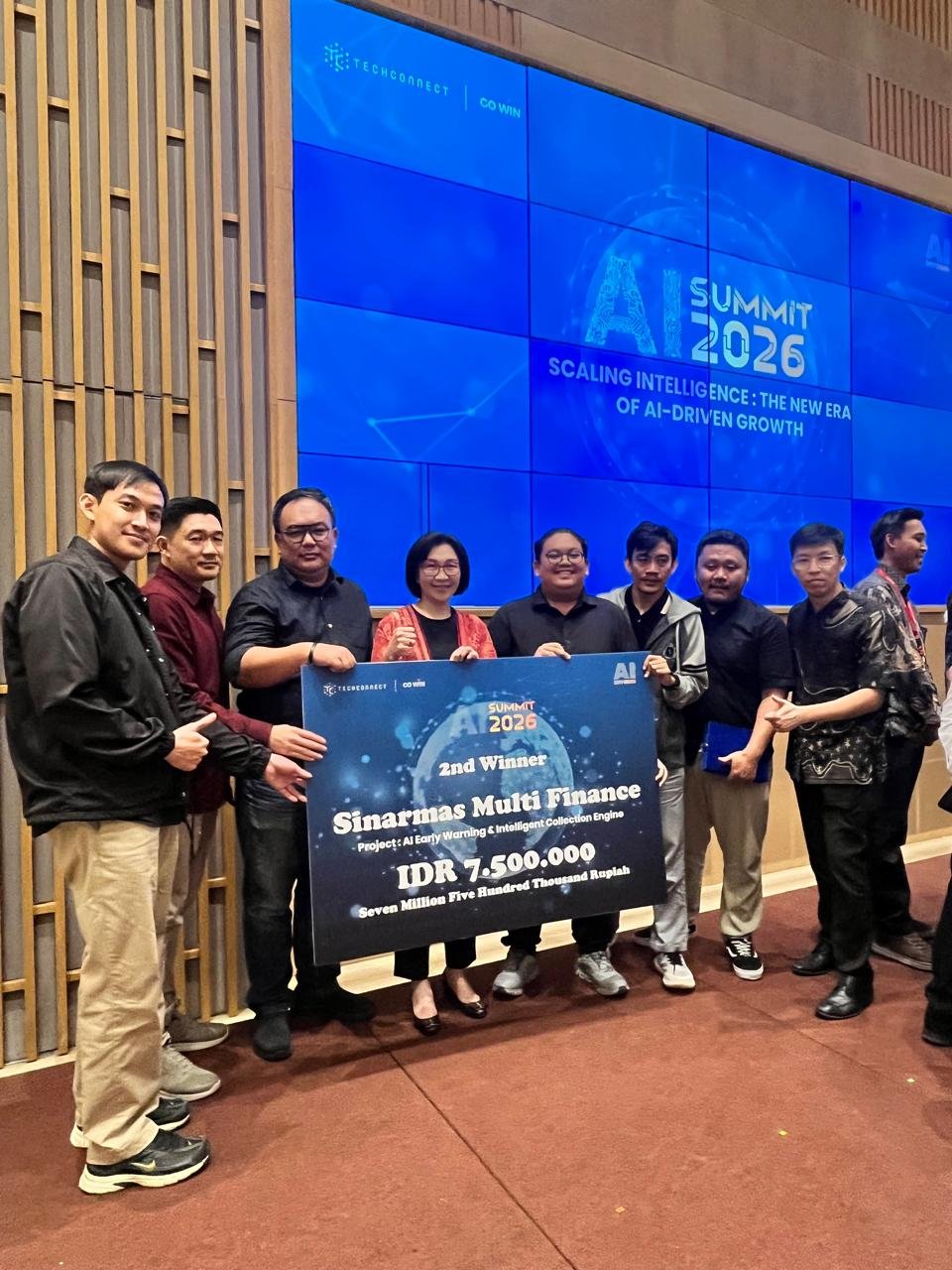
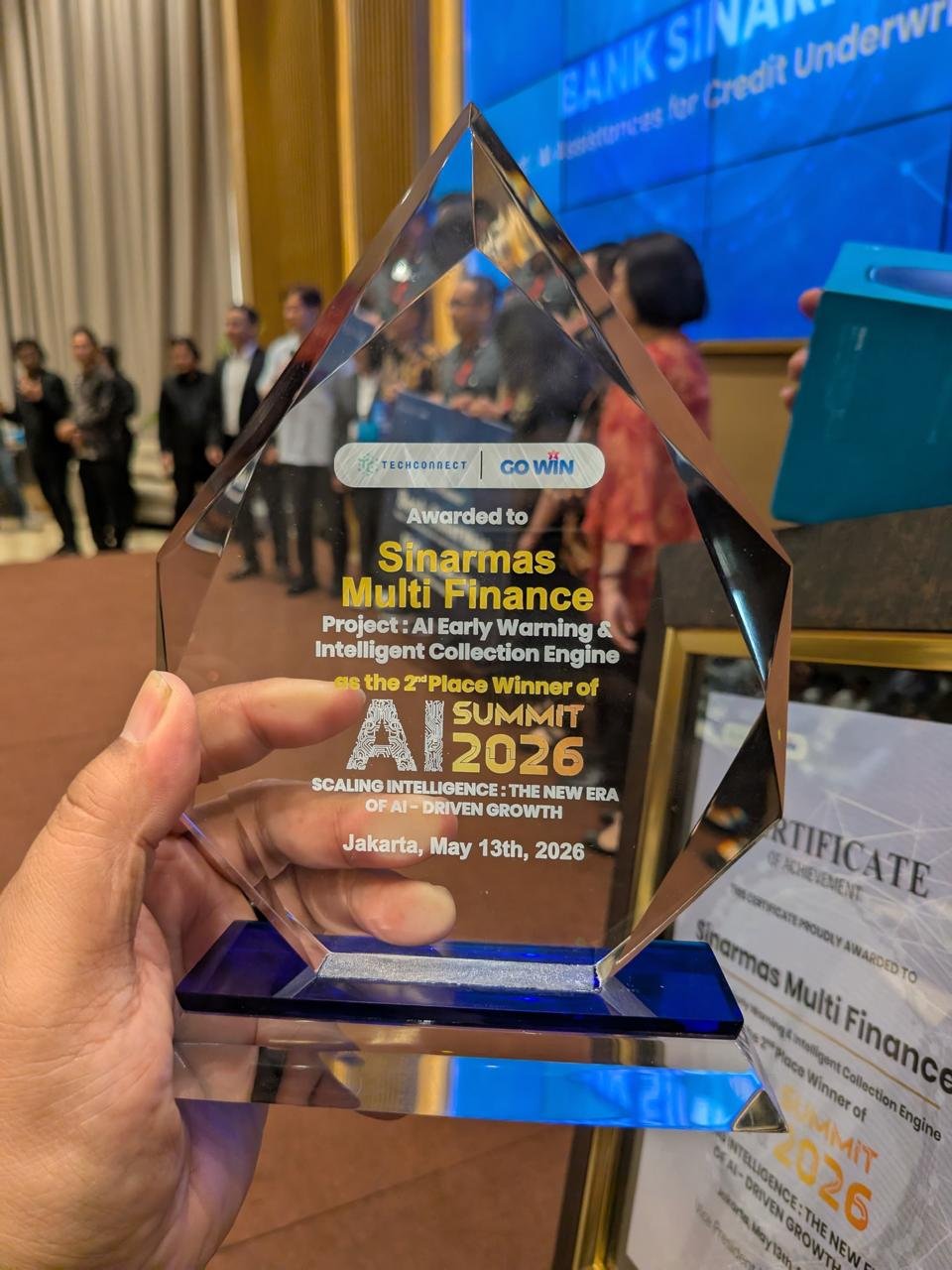
| Recognition | 2nd Place, AI Summit 2026 (TechConnect × CO WIN) |
TL;DR
Every morning, 200+ collection teams started with the same question — "who do we chase first?" — and answered it by guessing. The collection gap was worth billions of rupiah in receivables that never came back. I led ICDP, an AI early-warning engine that predicts which customers are likely to default 30 days before they do, and turns that prediction into a ranked daily action queue for every team. The pilot model validated at 87% accuracy, with a projected double-digit NPL reduction and multi-billion-rupiah annual savings. ICDP won 2nd Place at AI Summit 2026. This case study is less about the model and more about the product decisions.
1. Context
In a lending business, collection isn't a back-office function — it is the business. At scale, small percentage gaps in collection translate directly into billions of rupiah. The company had teams, processes, and SOPs. What it lacked was a way to answer one question well: of all the customers we could contact today, who should we contact first?
2. The Problem — "We knew who was late. We didn't know who would be late."
Teams worked from reactive lists built around customers who had already missed a payment, and prioritized them by intuition. There was no early signal — by the time a customer appeared on a list, the problem had already happened.
"I know who is overdue. I don't know who is about to be overdue." — a Head of Collection
The real problem wasn't "improve collection." It was: move the entire effort from reactive to predictive.
3. Discovery — Framing the problem before reaching for a solution
Time with collection leads and field teams made three things clear: the pain was universal but invisible in the data; it was a knowledge gap, not a tooling gap; and a prediction nobody acts on is worthless. That shaped the core principle: intelligence is only as valuable as the action it triggers.
4. The Strategic Bet — Why prediction, and why a platform
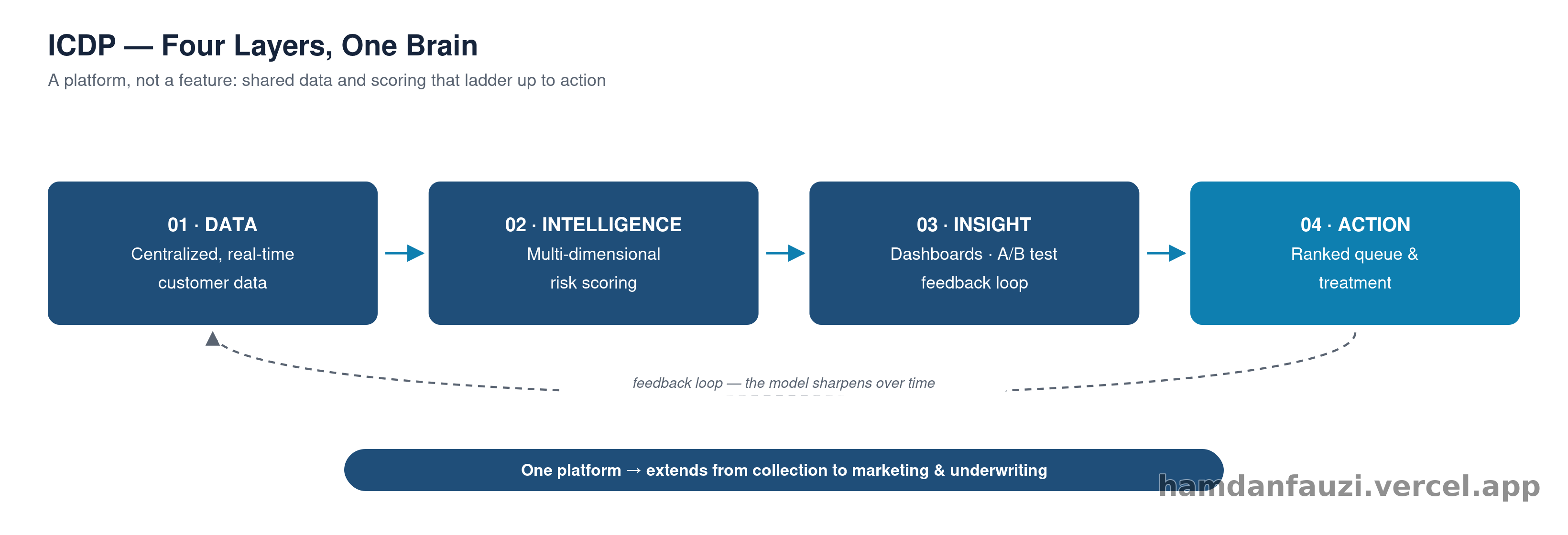
Cheaper options (better reporting, cleaner lists, more SOPs) all optimize the reactive model instead of replacing it. The bet was twofold: bet on prediction, and bet on a platform, not a feature — four layers, one brain:
| Layer | What it does |
|---|---|
| 01 · Data | One centralized, real-time customer data layer |
| 02 · Intelligence | Multi-dimensional risk scoring on unified data |
| 03 · Insight | Real-time dashboards, A/B testing, feedback loop |
| 04 · Action | Turns scores into a ranked queue & treatment |
5. Prioritization & Trade-offs — Deciding what not to build first
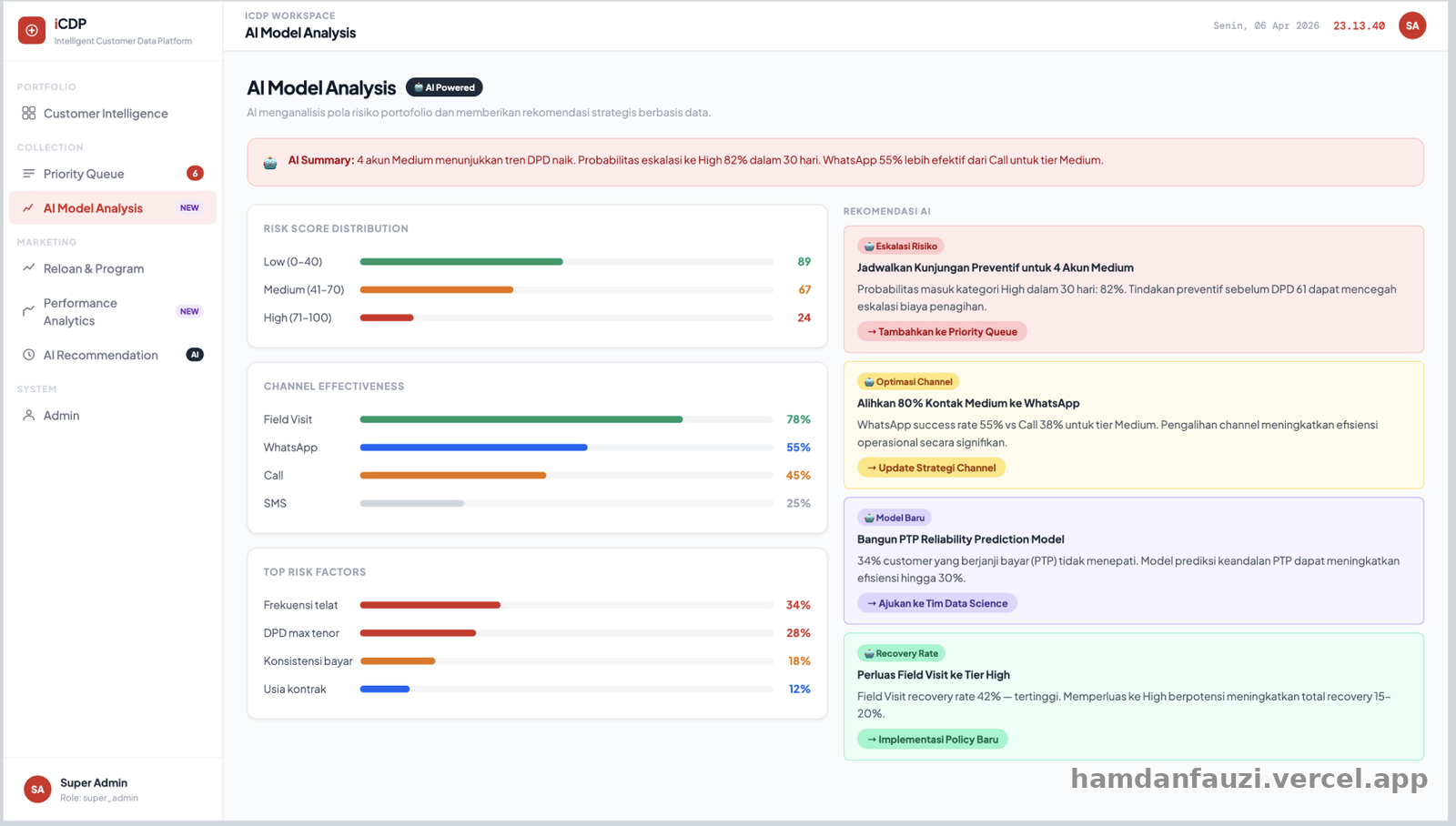
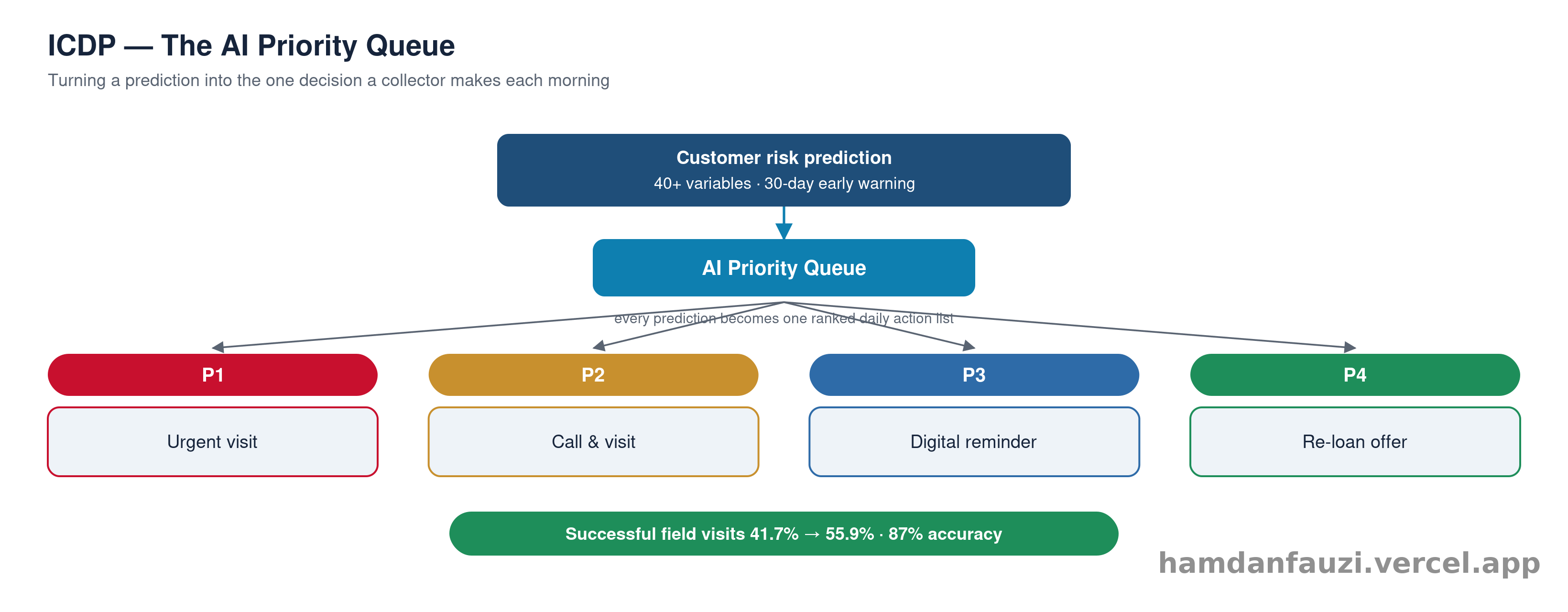
Collection Intelligence as the beachhead — the most acute and measurable pain, with a clean daily metric. Two modules, not ten — Customer Intelligence (a living risk profile on 40+ variables, 30-day early warning) and the AI Priority Queue (P1 visit · P2 call & visit · P3 digital reminder · P4 re-loan offer). And "right enough to act on" over perfect, to keep the pilot shippable. Marketing Intelligence stayed in scope but behind Collection.
6. Execution — Shipping in a regulated environment
Risk and Compliance were partners, not gatekeepers — brought in during design to decide what's automated vs. human and where the guardrails sit. The squad stayed small and cross-functional, and the feedback loop was designed in from day one so the model sharpens over time.
7. Impact
Validated: model at 87% accuracy with a 30-day early-warning window; a working AI Priority Queue for 200+ collection teams. Projected (Phase 1): double-digit NPL reduction, double-digit lift in collection effectiveness, multi-billion-rupiah annual savings. Recognition: 2nd Place, AI Summit 2026.
8. What's Next
Marketing Intelligence (re-loan, top-up, cross-sell targeting) and AI Underwriting ("Drive-Thru") — instant approval for low-risk, fast track for medium, human review for complex cases. Same thesis: decisions once made on assumption, made on data.
9. Reflections
The framing was the hard part, not the model. Adoption is a product feature — a prediction nobody acts on is worthless. Sequencing is leverage: saying "not yet" to good ideas was the highest-value decision I made. And in regulated product, compliance is a design input.
Some figures generalized for company confidentiality. The 87% accuracy is a measured pilot result.
"Dari asumsi bisnis ke keputusan berbasis data." — north star proyek ini.
Snapshot
| Peran | Product Manager — memimpin squad lintas fungsi end-to-end |
| Perusahaan | PT Sinarmas Multifinance — lender yang diatur OJK |
| Timeline | 2025 – sekarang (Fase 1 dipilot) |
| Tim | Product, Engineering, Tech Lead, UI/UX |
| Status | Fase 1 dipilot; model tervalidasi di akurasi 87% |
| Penghargaan | Juara 2, AI Summit 2026 (TechConnect × CO WIN) |
TL;DR
Setiap pagi, 200+ tim penagihan memulai dengan pertanyaan yang sama — "siapa yang ditagih duluan?" — dan menjawabnya dengan menebak. Celah penagihannya bernilai miliaran rupiah piutang yang tak kembali. Saya memimpin ICDP, mesin AI early-warning yang memprediksi konsumen mana yang berpotensi gagal bayar 30 hari sebelum terjadi, lalu mengubahnya jadi antrean aksi harian yang terurut untuk tiap tim. Model pilot tervalidasi di akurasi 87%, dengan proyeksi penurunan NPL dua digit dan penghematan miliaran rupiah per tahun. ICDP menang Juara 2 AI Summit 2026. Studi kasus ini lebih soal keputusan produk ketimbang modelnya.
1. Konteks
Di bisnis lending, penagihan bukan fungsi back-office — ia adalah bisnisnya. Dalam skala besar, selisih persen kecil pada penagihan langsung berarti miliaran rupiah. Perusahaan sudah punya tim, proses, dan SOP. Yang belum ada: cara menjawab satu pertanyaan dengan baik — dari semua konsumen yang bisa dihubungi hari ini, siapa yang harus dihubungi duluan?
2. Masalah — "Kami tahu siapa yang telat. Kami tak tahu siapa yang akan telat."
Tim bekerja dari daftar reaktif yang dibangun seputar konsumen yang sudah menunggak, dan memprioritaskannya pakai intuisi. Tak ada sinyal awal — saat konsumen muncul di daftar, masalahnya sudah terjadi.
"Saya tahu siapa yang menunggak. Saya tak tahu siapa yang akan menunggak." — seorang Head of Collection
Masalah sebenarnya bukan "perbaiki penagihan." Melainkan: geser seluruh upaya dari reaktif ke prediktif.
3. Discovery — Membingkai masalah sebelum mencari solusi
Waktu bersama collection lead dan tim lapangan memperjelas tiga hal: sakitnya universal tapi tak terlihat di data; ini kesenjangan pengetahuan, bukan tooling; dan prediksi yang tak ditindaklanjuti itu sia-sia. Itu membentuk prinsip inti: intelligence hanya sebernilai aksi yang dipicunya.
4. Taruhan Strategis — Kenapa prediksi, dan kenapa platform
Opsi lebih murah (reporting lebih baik, daftar lebih rapi, SOP lebih banyak) semuanya mengoptimalkan model reaktif, bukan menggantinya. Taruhannya dua: bertaruh pada prediksi, dan bertaruh pada platform, bukan fitur — empat layer, satu otak:
| Layer | Fungsinya |
|---|---|
| 01 · Data | Satu layer data konsumen tersentralisasi & real-time |
| 02 · Intelligence | Scoring risiko multi-dimensi di atas data terpadu |
| 03 · Insight | Dashboard real-time, A/B testing, feedback loop |
| 04 · Action | Mengubah skor jadi antrean terurut & treatment |
5. Prioritas & Trade-off — Menentukan apa yang TIDAK dibangun dulu
Collection Intelligence sebagai beachhead — sakit paling akut dan terukur, dengan metrik harian yang jelas. Dua modul, bukan sepuluh — Customer Intelligence (profil risiko hidup atas 40+ variabel, early-warning 30 hari) dan AI Priority Queue (P1 kunjungi · P2 telepon & kunjungi · P3 reminder digital · P4 tawaran re-loan). Dan "cukup akurat untuk ditindaklanjuti" ketimbang sempurna, agar pilot shippable. Marketing Intelligence tetap dalam scope tapi di belakang Collection.
6. Eksekusi — Merilis di lingkungan ter-regulasi
Risk dan Compliance jadi mitra, bukan penghambat — dilibatkan sejak desain untuk menentukan apa yang otomatis vs. manusia dan di mana guardrail-nya. Squad tetap kecil dan lintas fungsi, dan feedback loop didesain sejak hari pertama agar model makin tajam seiring waktu.
7. Dampak
Tervalidasi: model akurasi 87% dengan jendela early-warning 30 hari; AI Priority Queue yang berjalan untuk 200+ tim penagihan. Proyeksi (Fase 1): penurunan NPL dua digit, kenaikan efektivitas penagihan dua digit, penghematan miliaran rupiah per tahun. Penghargaan: Juara 2 AI Summit 2026.
8. Selanjutnya
Marketing Intelligence (targeting re-loan, top-up, cross-sell) dan AI Underwriting ("Drive-Thru") — approval instan untuk low-risk, jalur cepat untuk medium, review manusia untuk kasus kompleks. Tesisnya sama: keputusan yang dulu berbasis asumsi, kini berbasis data.
9. Refleksi
Framing adalah bagian tersulit, bukan modelnya. Adopsi itu fitur produk — prediksi yang tak ditindaklanjuti itu sia-sia. Sequencing adalah leverage: berkata "belum" ke ide-ide bagus adalah keputusan bernilai tertinggi yang saya buat. Dan di produk ter-regulasi, compliance adalah input desain.
Sebagian angka digeneralisasi demi kerahasiaan perusahaan. Akurasi 87% adalah hasil pilot terukur.